
CNC Swiss Machining Capabilities
Swiss machining is the go-to process when tolerances are tight, parts are small, and consistency across high volumes is non-negotiable. At Contour Tool, our 7-axis Swiss mill-turn center handles the complexity, turning, milling, and drilling in a single setup across a wide range of materials.
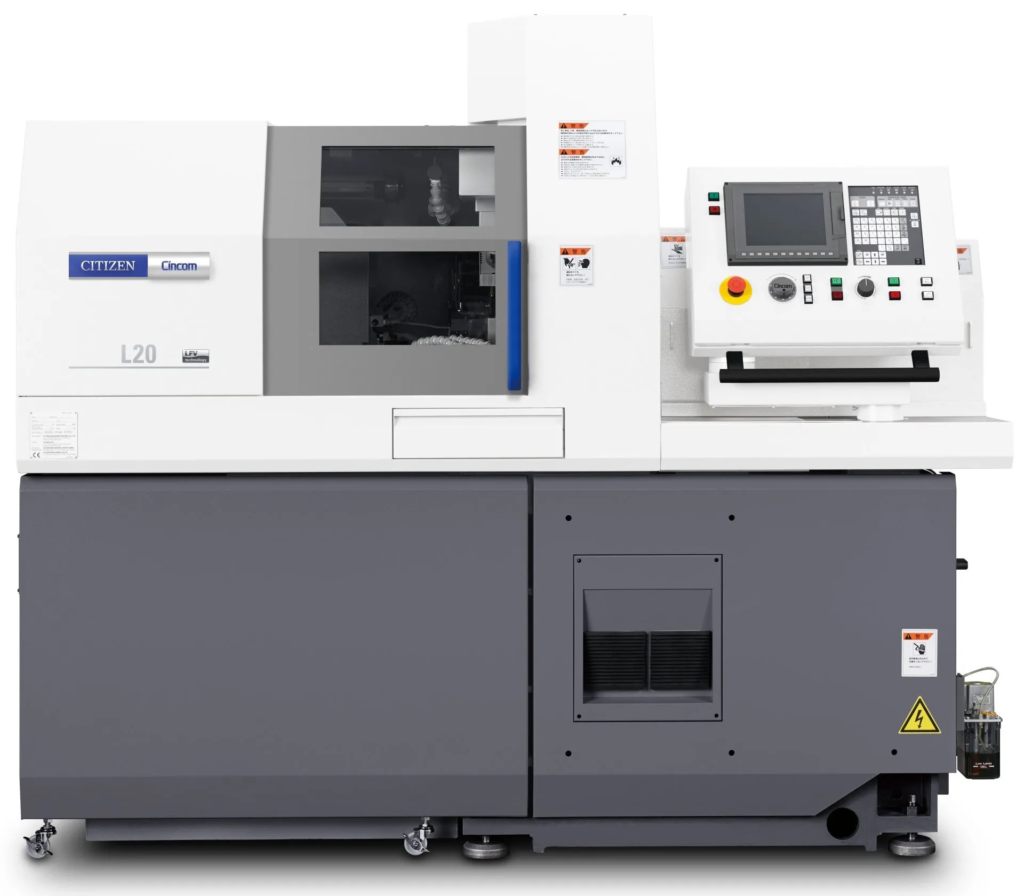
Swiss Mill/Turn Centers
- (1) Citizen L320VIII
- 7 axis capability
- Live Tooling for Face and Cross drilling and milling
- 1” diameter bar capacity option
- LNS GT326-E Magazine bar feeder
- Low Frequency Vibration (LFV)
Contour Tool offers 7-axis precision CNC Swiss machining services, utilizing advanced mill-turn technology and working with a wide range of materials including aluminum, stainless steel, steel, brass, bronze, and copper. This capability delivers exceptional precision for complex, close-tolerance components with bar capacities up to 1 inch in diameter, producing intricate parts that demand high accuracy and repeatability. Ideal for demanding applications across industries as it supports diverse production needs—from challenging low-volume runs to high-volume output in excess of 500,000 pieces. Contour Tool leverages Swiss machining to streamline manufacturing, reduce supply chain complexity, and provide innovative solutions for projects that other shops may decline.
Introduction to Swiss CNC Machining
Swiss CNC machining — also called Swiss turning — is a precision turning process designed for small-diameter, complex parts that demand extremely tight tolerances. What sets it apart from conventional CNC turning is the guide bushing: a support mechanism that holds the workpiece close to the cutting tool throughout machining, minimizing deflection and enabling exceptional accuracy even on slender or delicate components. The result is the ability to machine intricate features, tight tolerances, and multiple operations — turning, milling, and drilling — all in a single setup.
Swiss machining is particularly well-suited for high-volume production of small, complex parts where consistency across thousands — or hundreds of thousands — of pieces is non-negotiable. The guide bushing supports the workpiece along its full length, which is what makes Swiss turning the go-to process for components like bone screws, dental instruments, and small aerospace parts with complex geometries and tight dimensional requirements.
Swiss Mill/Turn Centers
- (1) Citizen L320VIII
- 7 axis capability
- Live Tooling for Face and Cross drilling and milling
- 1” diameter bar capacity option
- LNS GT326-E Magazine bar feeder
- Low Frequency Vibration (LFV)
A note on Low Frequency Vibration (LFV): Our Citizen L320VIII is equipped with LFV cutting technology, which breaks chips into smaller fragments during machining. This is especially valuable when working with materials like stainless steel and titanium that tend to produce long, stringy chips — reducing the risk of chip buildup, protecting the cutting tool, and maintaining surface finish quality on demanding medical and aerospace components.
Contour Tool offers 7-axis precision CNC Swiss machining services, utilizing advanced mill-turn technology and working with a wide range of materials including aluminum, stainless steel, steel, brass, bronze, and copper. This capability delivers exceptional precision for complex, close-tolerance components with bar capacities up to 1 inch in diameter, producing intricate parts that demand high accuracy and repeatability. Ideal for demanding applications across industries as it supports diverse production needs—from challenging low-volume runs to high-volume output in excess of 500,000 pieces. Contour Tool leverages Swiss machining to streamline manufacturing, reduce supply chain complexity, and provide innovative solutions for projects that other shops may decline.
Additional Capabilities and Services
CNC Precision Machining
View CapabilitiesValue Added Services
View ServicesInventory Management
Learn MoreQuality
Learn MoreProduct Gallery
View GalleryWhat is CNC Swiss machining?
CNC Swiss machining is a high-precision turning process used to produce small-diameter, complex parts with extremely tight tolerances. Guided by computer-controlled instructions, Swiss turning centers can perform multiple operations — turning, milling, and drilling — in a single setup, making them especially well-suited for intricate components that demand both accuracy and repeatability. At Contour Tool, our 7-axis Citizen L320VIII Swiss mill-turn center handles everything from challenging low-volume runs to high-volume production in excess of 500,000 pieces, across materials including aluminum, stainless steel, brass, bronze, and copper.
Why is it called a Swiss machine?
The Swiss machine gets its name from its origins in the Swiss watchmaking industry, where the demand for extremely small, precise components drove the development of a new kind of lathe in the late 19th century. Swiss watchmakers needed a reliable way to produce the tiny, intricate parts that mechanical timepieces required — and the guide bushing design that defines Swiss machining today was the solution. The technology has since expanded far beyond watchmaking, but the name stuck.
What is the difference between a Swiss machine and a conventional lathe?
The key difference is how the workpiece is supported during cutting. On a conventional lathe, the workpiece is held at one end and can flex or deflect as the cutting tool moves along it — which limits accuracy on long, slender parts. A Swiss machine uses a guide bushing that supports the workpiece right at the point of cut, virtually eliminating deflection. This makes Swiss machining far more capable when it comes to small-diameter parts, tight tolerances, and complex features that a conventional lathe simply can’t hold consistently.